Saturday, April 16, 2011

Module 12 | Nevermore


PLOT SUMMARY
The book provides an overview of the life of Edgar Allan Poe, beginning with his mother's death and father's abandonment when Poe was a toddler. Nevermore details Poe's informal adoption by the Allan family; his troubles as a student; his early writing jobs; his marriage to his cousin, Virginia; and his bouts with alcoholism. The book discusses Poe's contribution to fiction, particularly his influence on the American short story. The fact that Poe's reputation was often maligned during his lifetime is sure to interest young readers who know only of the author's modern reputation.

MY IMPRESSIONS
The book does an excellent job of profiling Poe, as author Karen Lange gives the writer's talent its full due while never shying away from Poe's flaws. Nevermore will likely heighten the way young readers examine Poe's work, as it is easy to see the influence the many sad events in his life ─ specifically the early deaths of his mother and wife ─ had on his writing. The photographs are excellent enhancements to the text, as they illustrate how Poe's struggles with the bottle began to take a toll on his youthful good looks. It's also wonderful to see the many personalities mentioned in the text, including Poe's wife, mother, and foster parents, as well as his various allies and enemies in the publishing field. Overall, Nevermore is an excellent example of biography for middle school and high school audiences.

REVIEWS
"The book compactly covers Poe’s dramatic life from his early orphaning and his tempestuous relationship with his foster father to his growing writing career and his tempestuous relationship with his fellow writers ... The author gives full acknowledgment of Poe’s bouts of self-torment and alcoholism, but she also makes clear that he had his sunny and amiable days as well, and he seems all the more mysterious and glamorous as a result of the even-handed treatment."
Deborah Stevenson, The Bulletin of the Center for Children’s Books, May 2009, Vol. 62, No. 9

"Lange’s emphasis on the many tragedies that shaped Poe’s short life as well as upon the historical and cultural elements that influenced his society gives readers a vivid sense of his struggles ... Lange’s volume demonstrates that Poe’s own tale is a worthy competitor with any of the stories he wrote."
Megan Lynn Isaac, VOYA, August 2009, Vol. 32, No. 3

"This book would be a wonderful way to introduce a unit on Poe to students or as a resource for research into Edgar Allan Poe. It is also a good book for browsers or those curious to learn more about the author’s life and works."
Anne Hoffman, Catholic Library World, June 2010, Vol. 80, No. 4

USES IN THE LIBRARY
The book could be featured as part of an "Edgar Allan Poe Day" celebration at the library, which could take place around the same time as Poe's birthday (January 19). Nevermore would be an excellent resource to showcase when discussing non-fiction works about the author's life, while other activities could include a gothic poetry contest; read-alouds of a few of his short-stories; and a screening of a movie based on one of his works, such as The Fall of the House of Usher. In addition, Nevermore could be included on a list of books aimed at teens that deal with the lives of famous artists, especially as many teens begin to familiarize themselves with Poe's work in middle school and high school.

CITATION

Lange, K. (2009). Nevermore: A photobiography of Edgar Allan Poe. Washington, D.C.: National Geographic.

Monday, April 4, 2011

Module 11 | Witch-hunt: Mysteries of the Salem Witch Trials


PLOT SUMMARY
Author Marc Aronson explores the events that led to the Salem witch trials, as well as the grave injustices that occurred during the nearly yearlong hysteria. He provides details of the accusers, the accused, the court system, and the physical and social environment of the late 17th century. Such recognizable personalities as Tituba, Cotton Mather, Giles Cory, John Proctor, and Martha Carrier (the so-called "Queen of Hell") are discussed. One of the more interesting aspects of the book is Aronson's comparisons of the witch trials to modern day American society, as well as his discussion of the witch trials in regards to the fairy tales and folk tales many of us have grown up with.

MY IMPRESSIONS
The book does an excellent job of answering the question most young adults have about the Salem witch trials: How could anyone have believed their friends and neighbors were witches? By explaining the way in which people of the time viewed the world through a heavily theological lens, he makes it easier to comprehend how something so tragic could have transpired. This book will no doubt enthrall readers ranging from middle schoolers to high schoolers. It's likely the well-written Witch-Hunt will inspire lively discussion regarding Salem's parallels to other events in American history.

REVIEWS
"Presenting the best scholarship, various interpretations of the events, and the mysteries that remain, Aronson encourages readers to think for themselves and perhaps discover something new about the trials."
Kirkus Reviews, October 15, 2003, Vol. 71, No. 20

"This accessible, well-written addition further illuminates a popular topic. Young historians will be guided to find their own answers in their quest to understand American history."
Marian Rafal, VOYA, December 2003, Vol. 26, No. 5

"This is not the place for novices to begin sorting through the tangled story of the trial, but readers with an established and avid interest should appreciate Aronson’s infectious enthusiasm and his proposed path for further study."
Elizabeth Bush, The Bulletin of the Center for Children's Books, December 2003, Vol. 57, No. 4

USES IN THE LIBRARY
The book would be an excellent addition to a display of fiction and non-fiction books about the witch trials. North Texas libraries could extend an invitation to author Kathleen Kent to speak on the topic; Kent lives in Dallas and wrote the witch-trial inspired The Heretic's Daughter. Kent is a descendant of accused witch Martha Carrier, who was sentenced to death at the Salem trials and is discussed at detail in Witch-Hunt. In addition, the book could inspire a book talk on other fiction or non-fiction titles that center on injustice.

CITATION
Aronson, M. (2003). Witch-hunt: Mysteries of the Salem witch trials. New York: Atheneum Books

Wednesday, March 30, 2011

Module 10 | Tomás and the Library Lady


PLOT SUMMARY
Young Tomás travels with his family each summer from Texas to Iowa to work the land. Tomás loves his grandfather's cuentos, and exuberantly shouts out the ending to each one. Papá Grande suggests that Tomás should visit the library to find even more stories. Tomás' discovery of the library's many books, as well as the friendly librarian with whom he shares them, changes his life.

MY IMPRESSIONS
The story – based on the life of Tomás Rivera, who rose to become chancellor at the University of California at Riverside – is touching without being saccharine; Tomás is a likable protagonist who will no doubt inspire children (especially Latino children) to visit the library. The relationships between characters – specifically Tomás and his grandfather and Tomás and the library lady – are all portrayed in a positive manner, showing how Tomás values his roots while also embracing the idea of expanding his worldview. Tomás and the Library Lady is a fantastic entry in the historical fiction genre.

REVIEWS
"This is a warm and attractive tribute to the power of libraries and librarians, but it may be a bit too stodgy to evoke a response in young readers."
Pat Mathews, The Bulletin of the Center for Children's Books, October 1997, Vol. 51, No. 2

"Colon's beautiful scratchboard illustrations, in his textured, glowingly colored, rhythmic style, capture the warmth and the dreams that the boy finds in the world of books."
 Hazel Rochman, Booklist, Aug. 1997, Vol. 93, No. 22

"A heartwarming story for children from all backgrounds."
Cheryl Peterson, Children's Literature, 1997
To read Peterson's full review, visit:
http://www.childrenslit.com/childrenslit/mai_mora_pat.html

USES IN THE LIBRARY
This would be a good selection for a story time in connection with El Día de los Niños. In addition, the book could inspire librarians to set up an activity once a month in which struggling English-language learners could read aloud to staff as a way to practice their language skills (and perhaps teach monolingual staff members Spanish words in return).

CITATION
Mora, P. (1997). Tomás and the library lady. New York: Knopf.

Monday, March 21, 2011

Module 9 | The Stranger Next Door


PLOT SUMMARY
Written by Peg Kehret and "Pete the Cat," the book chronicles the struggles of Alex as he begins life at a new school after his parents move to a housing development across town. He thinks that maybe he can form a friendship with his new neighbor, Rocky, but finds the boy aloof. Unknown to Alex, Rocky is in the Witness Protection Program and is weary of making new friends for fear he and his family might have to flee again. When odd events begin to take place at the housing development, Alex wonders if Rocky might be to blame, but Alex's cat Pete has another suspect in mind (and scent).

MY IMPRESSIONS
Overall, the book does a good job of sustaining the mystery throughout, including who is behind the ordered hit on Rocky's family and who is wreaking havoc on the housing development. The contributed passages by Pete are cute and witty, providing a nice counterbalance to the cluelessness of his human counterparts.

REVIEWS
"Kehret packs a lot of action and tension in this easy-to-handle mystery, leavening it nicely with Pete's entertaining swaggering and sleuthing."
Chris Sherman, Booklist, Feb. 1, 2002, Vol. 98, No. 11

"This mystery involving secret identities, school bullies, arson, and monetary gain holds special appeal for young teens and reluctant readers."
Patricia Morrow, VOYA, February 2002, Vol. 24, No. 6

"Readers will be caught up in the action even as they are amused by Pete's astute observations and adroit detective work."
Kirkus Reviews, March 15, 2002, Vol. 70, No. 6

USES IN THE LIBRARY
Young adult mystery novels such as The Stranger Next Door could inspire a "Mystery Game Night" event, where board games such as Clue and Guess Who? could be used to entertain younger kids, while a mystery-theater-style detective game could be crafted for older kids. In addition, the book would be a great choice for a book club, as it might intrigue reluctant readers, which could then lead them to other Peg Kehret novels, as well as more mystery books.

CITATION
Kehret, P. (2002). The stranger next door. New York: Dutton Children's Books.

Module 8 | The Magic Half


PLOT SUMMARY
Young Miri has always felt out of place in her family; her younger twin sisters and older twin brothers make her the odd one out. After her family moves into a new home, Miri discovers an old eyeglass lens taped to the baseboard in her new room. The lens transports Miri to 1935, where she discovers young Molly, a former resident of Miri's room. Miri is determined to help Molly escape from her unloving family and maybe just transport her to the present along the way.

MY IMPRESSIONS
The Magic Half is undeniable fun, an engrossing time travel romp that leaves you rooting for its incredibly likable heroines. The story harbors some darker, almost fairy-tale-esque aspects in the treatment of Molly by her family, which makes Miri's hilarious plan to rid Molly of her terrible cousin Horst especially satisfying. The book expertly adheres to its own logic, which should make it a favorite among young readers, especially those interested in fantasy.

REVIEWS
"The characters and setting are realistic despite the subtle elements of magic and time travel. Barrows conjures up a delightful tale brimming with mystery, magic, and adventure that will surely enchant readers everywhere."
Laura Butler, School Library Journal, Dec. 1, 2008, Vol. 54, No. 12

"Barrows limits the fantasy to the simple but effective time-travel device, using it sparingly as Miri bravely sets about making things right for her new friend ─ and eventually herself. Readers will savor the author's lively observations."
Publishers Weekly, Dec 17, 2007, Vol. 254, No. 50

"This is a handy introduction to time travel for a younger set; the rules are not so complex as to befuddle the reader, but they’re intricate enough to pique interest and challenge precepts, and it’s always a revelatory exercise to look at today’s world through the eyes of someone living over seventy years ago."
Katrina Bromann, The Bulletin of the Center for Children’s Books, February 2008, Vol. 61, No. 6

USES IN THE LIBRARY
Miri's search for various objects ─ including a necklace and eyeglass lens ─ would make for a fun tie-in with a scavenger hunt, in which kids could locate clues hidden in different books throughout the library to find items related to The Magic Half. The book could also be a part of a display showcasing children's materials related to time travel.

CITATION
Barrows, A. (2007). The magic half. Bloomsbury USA Children's Books: New York.

Module 7 | Tangerine


PLOT SUMMARY
When Paul Fisher and his family move from Texas to Florida — mainly in an effort to secure his brother’s future, which Paul refers to as the “Erik Fisher Football Dream” — their new home is as odd as its name. Still, Paul finds he likes the new town, especially after a natural disaster forces his move to a middle school on the poorer side of town. Here, he discovers a new group of friends and is allowed to play soccer despite the fact that he is legally blind. Although it’s Paul who has the failing eyesight, he seems to be the only one who can see the wrongdoing for which his brother is responsible.

MY IMPRESSIONS
Tangerine is a wonderful book that tackles a number of issues sure to hit home with young adults, including strained familial relations, racism, and disability, to name a few. Still, Bloor’s story is never preachy or overwrought, sustaining a fantastic sense of mystery throughout (the reader is sure to be especially invested in the question of how Paul’s blindness originated). Paul is a terrific protagonist, smart without being a smart aleck and sympathetic without being simpering; kids are sure to appreciate his candor. This book is also an excellent choice for boys seeking a main character to whom they can relate.

REVIEWS
"This is an exciting, suspenseful, and thought-provoking book that should be a hit with soccer-playing middle schoolers."
Brenda Moses-Allen, VOYA, August 1997, Vol. 20, No. 3

" ... the book has a lot going for it, especially the atmospheric portrait of the eerie community, where lightning strikes more often than it does anywhere else and a school is swallowed by a sinkhole. One thing is for sure: this dark debut novel proves that Bloor is a writer to watch."
Kathleen Squires, Booklist, May 15, 1997, Vol. 93, No. 18

"There are many dynamic characters in the book, including the protagonist Paul. Underneath everything, I think the story is about how to be true to oneself and to stand up for what is right even in the face of adversity."
Melissa Osztrosits, Kutztown University Book Review, Spring 2007

USES IN THE LIBRARY

Tangerine would be a good choice for a book talk for a 12- to 14-year-old (particularly male) audience; it could be paired with such books as The Chocolate War and Maniac Magee, which also focus on male protagonists. Also, it would be a good choice for a display in which kids could select titles that celebrate different sports they love; Tangerine would easily fit into the soccer mold.

CITATION
Bloor, E. (1997). Tangerine. Boston: Harcourt Children's Books.

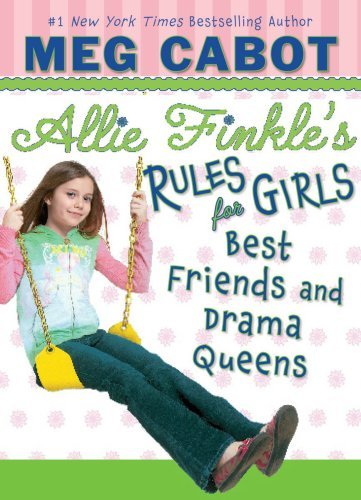
Module 7 | Allie Finkle's Rules for Girls: Best Friends and Drama Queens


PLOT SUMMARY
Allie and her best friends Caroline, Sophie, and Erica, are excited to meet Cheyenne, the new girl in their fourth grade class, especially since she’s from Canada (!) But despite Allie’s initial infatuation with Cheyenne’s “talent” T-shirt and high-heeled boots, she begins to resent Cheyenne’s emphasis on boys, as well as her cruel taunts of “Big Baby Finkle!” Allie and her friends must decide if they want to go along with Cheyenne’s ideas of “going together” or stay regular fourth graders who love to play Queens.

MY IMPRESSIONS
Author Meg Cabot nails the perspective of a 10-year-old girl, especially in Allie’s observations of Cheyenne’s clothing and facial expressions; her adoration of her pretty teacher; and the awe she and her friends feel at a new student arriving all the way from Canada. The book makes it easy to become invested in the girls’ problems, especially as they are increasingly ostracized by the rest of their class. The conclusion of Rules for Girls sends just the right message to this age group: Don’t grow up too fast.

REVIEWS
"Using Allie’s fresh voice and believable fourth-grade perspective, Cabot gets across her “let children be children” message in a way that will make sense to other kids. The third Allie Finkle’s Rules for Girls book sympathetically portrays the broad emotional range of fourth-graders."
Carolyn Phelan, Booklist, Nov. 15, 2008, Vol. 105, No. 6

" ... the author addresses preteen agony by rendering boys and girls alike in a three-dimensional light, even Allie's pesky younger brothers and her quirky young Uncle Jay, who suffers from a broken heart."
Kirkus Reviews, February 1, 2009, Vol. 77, No. 3

"While this story could easily be used to help children in specific social situations, it is fun and engaging enough for them to pick up on their own and includes universal themes that will touch many."
Jennifer Lehmann, Children's Literature, 2009

USES IN THE LIBRARY
A “What are YOUR Rules?” contest would be a great way to get young girls excited about the book, as they could post their most important rules from their own lives on a bulletin board at the library or through the library's web site. The series would also be a good book club selection for 8- to 10-year-olds, as kids could discuss various entries in the Allie Finkle collection.

CITATION
Cabot, M. (2009). Allie Finkle's rules for girls: Best friends and drama queens. New York: Scholastic Press.